 South Korea
 Transportation: KTX Trains, Subways, Buses and Taxis
South Korea transportation is fast, cheap and easy once you know three things: take the KTX between cities, tap a transit card on the subway, and navigate with a Korean map app like Naver Map. The high-speed train gets you from Seoul to Busan in about 2 hours 10 minutes on the fastest services, and a metered taxi starts under $4.
Here's how each piece works, what it costs as of October 2026, and where visitors get tripped up.
KTX train: travel times from Seoul
The KTX is Korail's high-speed train, with a top speed of 330 km/h (about 205 mph), according to the Korea Tourism Organization's train guide. Trains to Busan and Daegu leave from Seoul Station, trains toward Gwangju and Mokpo from Yongsan, and trains to Gangneung and the KTX-Eum services on the Jungang Line from Seoul and Cheongnyangni. Trains from Suseo Station in southern Seoul to Busan and Mokpo used to run as the separate SRT; since KTX and SRT operations were integrated on September 1, 2026, they run as KTX (the former SRT trains are now called KTX-Sancheon).
| Destination | Approximate time | Notes |
|---|---|---|
| Dongdaegu (Daegu) | About 1 hr 45 min | From Suseo (former SRT): about 1 hr 40 min |
| Gangneung | About 1 hr 50 min | Gangneung Line, east coast |
| Gyeongju | About 2 hr 5 min | KTX-Eum on the Jungang Line |
| Busan | About 2 hr 10 min on the fastest trains | Many trains take 2 hr 30 min or more with extra stops |
| Pohang | About 2 hr 25 min | KTX-Eum on the Jungang Line |
| Busan to Gyeongju | About 50 min | Useful for a Busan base |
These times come from Korea Tourism Organization regional guides and Korail service announcements. Schedules change, so check the exact train in the Korail+ app before you build a tight day around it. The South Korea map shows where each city sits.
How to book KTX tickets
Since October 1, 2026, tickets go on sale two months before departure (it used to be one month), and you can buy them until shortly before the train leaves, through Korail's website, the Korail+ app (which replaced KorailTalk in August 2026), station kiosks and ticket windows. Foreign credit cards work at station machines and counters. Book ahead for weekends and Korean holidays, when popular trains sell out. Korail's English customer line is +82-1599-7777.
Is the Korail Pass worth it?
The Korail Pass gives foreign visitors unlimited rides on Korail trains, including KTX, on 2, 3, 4 or 5 days of your choice within 10 days. These are the 2026 prices shown by Korail Pass sellers as of October 2026; confirm the current price on the official Korail Pass page before you buy.
| Pass | Adult (13 and over) | Child (6 to 12) |
|---|---|---|
| 2 days within 10 days | ₩131,000 (about $98) | ₩66,000 (about $50) |
| 3 days within 10 days | ₩186,000 (about $140) | ₩93,000 (about $70) |
| 4 days within 10 days | ₩234,000 (about $176) | ₩117,000 (about $88) |
| 5 days within 10 days | ₩275,000 (about $207) | ₩138,000 (about $104) |
The rules that matter: you need a passport to buy and to board, and Korean nationals can't use it. You can reserve seats up to twice a day and book standing tickets as often as you like, and first class costs 50% of the first-class fare. The pass does not cover subways or temporary tourist trains. It also excluded the SRT, and Korail had not clearly updated the pass terms for the former SRT trains from Suseo as of October 2026, so confirm before you count on them. Refunds are only possible before the pass's start date. Older guides quote lower prices and consecutive-day passes, so check against Korail directly.
Is it worth it? Do the math with your route. The pass pays off if you're doing several long legs in a few days, such as Seoul to Busan, Busan to Gyeongju and back to Seoul. If you're only making one round trip, single tickets are usually simpler. The South Korea itinerary page lays out routes that use the train well.
Korail Pass Plus: for an extra ₩8,000 (about $6), pass holders can add a NAMANE transit card for subways and buses nationwide, picked up at kiosks at Incheon Airport and major stations. Check current terms on the Korail Pass Plus site before you pay.
Transportation in South Korea's cities: subway, bus and T-money
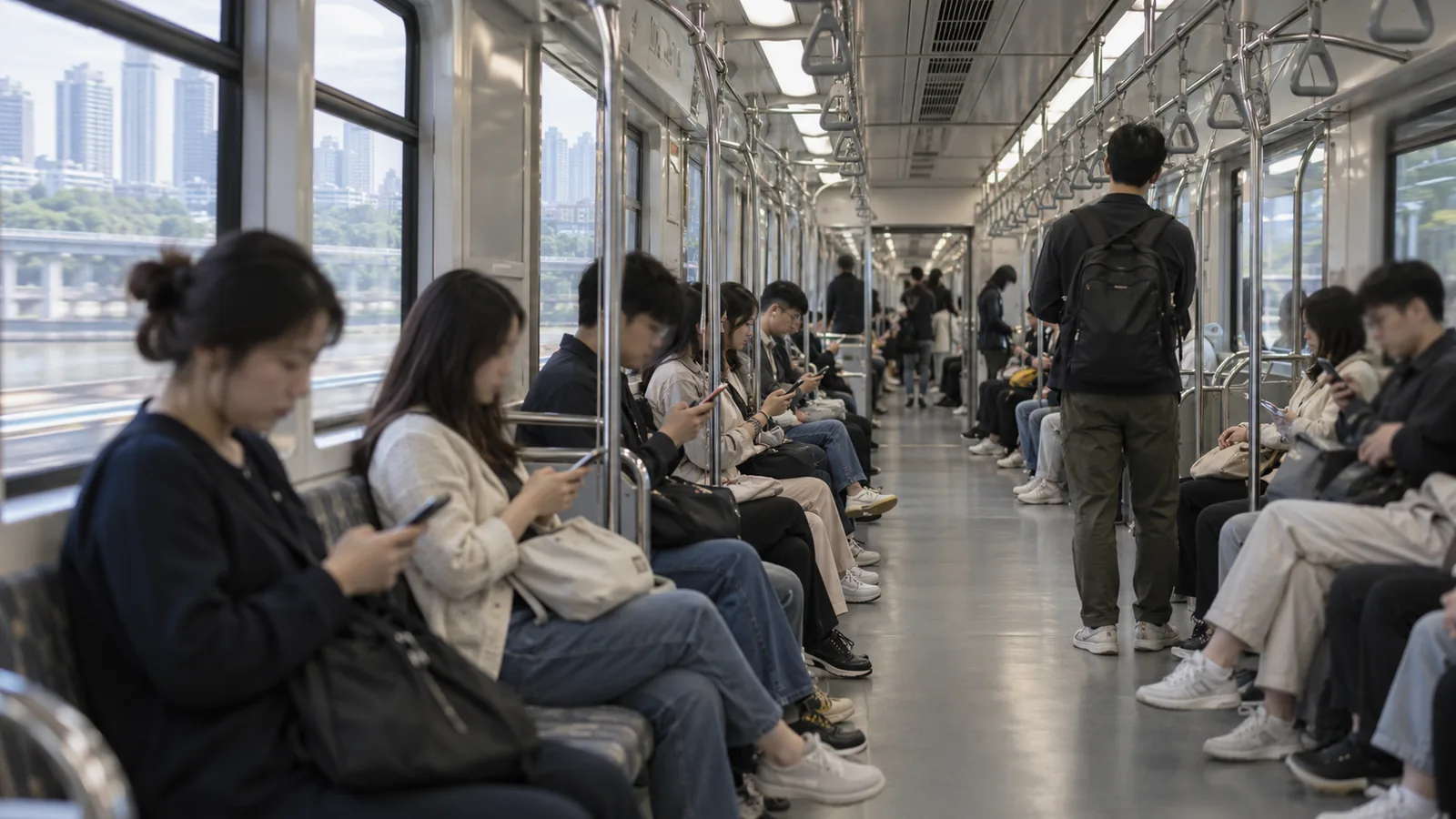
Seoul, Busan and Daegu all have subway systems, and Seoul's network reaches well into the suburbs. You pay by tapping a card at the gate, and transfers between subway and bus are discounted if you tap out and tap in again within 30 minutes (one hour between 21:00 and 07:00).
| Card | Card cost | How it works | Watch out for |
|---|---|---|---|
| T-money | ₩3,000 to ₩5,000 | Stored value; works on subways, buses and many taxis nationwide | Top up with cash; foreign cards don't work for purchase or top-up |
| Climate Card (Seoul) | ₩3,000 card, plus pass from ₩5,000 for 1 day to ₩20,000 for 7 days | Unlimited Seoul subway and Seoul bus rides | Seoul only from October 1, 2026; excludes Sinbundang Line; buy with cash |
| WOWPASS | ₩5,000 | Prepaid card loaded at kiosks in KRW or foreign cash | Needs a passport and app activation |
For most visitors, a T-money card from any GS25, CU or 7-Eleven is the simple choice. The Climate Card only makes sense if you'll ride a lot in Seoul over a few days. The KTO transit card page has full details and was updated in August 2026.
Getting in from Incheon Airport
The AREX Express train runs nonstop from Incheon Terminal 1 to Seoul Station in about 43 minutes (about 51 minutes from Terminal 2). The all-stop train takes about 59 minutes from Terminal 1 and stops at Hongik University Station, handy if you're staying in Hongdae. The Seoul guide covers neighborhoods.
Taxis, Kakao T and k.ride
Taxis are metered and reasonably priced. The base fare for a regular taxi in Seoul and Busan is ₩4,800 (about $3.60) for the first 2 km (1.2 miles). Black deluxe taxis start at ₩6,500 in Seoul. A late-night surcharge applies roughly 22:00 to 04:00 and is highest from 23:00 to 02:00. Drivers take cash, cards and T-money, and you don't tip.
Kakao T is the app Koreans use to call a cab. Visitors can use k.ride, Kakao Mobility's English-language version, which accepts foreign credit cards and Google or Apple login. Uber Taxi also works in Korea through the normal Uber app.
Express buses and domestic flights
Express buses go almost everywhere the train doesn't and often cost less. Seoul has several terminals, and buses to the same city can leave from different ones: Seoul Express Bus Terminal (Lines 3, 7 and 9) for Busan, Daegu and Gangwon; Central City Terminal next door for Jeonju, Gwangju and Mokpo; and Dong Seoul Terminal (Line 2, Gangbyeon Station) for much of the country. Seoul to Jeonju takes about 2 hours 40 minutes by express bus. Book on kobus.co.kr or at the terminal.
Fly for Jeju. Gimpo to Jeju is one of the busiest air routes in the world, and both airports are served by Korean Air, Asiana, Jeju Air, Jin Air, T'way and several other carriers. Flights also leave from Busan's Gimhae Airport. Details are in the Jeju Island guide and the flights to South Korea page.
Driving in South Korea
You can drive with an International Driving Permit (IDP) plus your US license; the State Department says an IDP or Korean license is required for all drivers. Korea drives on the right. Rental companies require drivers to be over 21 and to pay with a credit card in the driver's own name. The legal blood alcohol limit is 0.03%, and police run regular checkpoints.
Honestly, you don't need a car in Seoul or Busan. Rent one on Jeju, where buses are slower and the best stops are spread out. If your rental has no Hi-pass toll device, avoid the blue Hi-pass lanes at toll plazas.
Navigation apps that work in Korea
Install Naver Map or KakaoMap before you land; both have English menus and give accurate subway, bus and walking directions. Add Korail+ for trains and k.ride for taxis. Searching in Korean (copy and paste from a hotel confirmation) gets better results than English names.
Next step: sketch your city order, add up the long train legs, and compare them with the pass prices above. Then read our South Korea travel tips for SIM cards, money and emergency numbers.
Frequently asked questions
How long is the KTX from Seoul to Busan?
About 2 hours 10 minutes on the fastest trains, and many trains take 2 hours 30 minutes or more because of extra stops. Check the exact train in the Korail+ app before booking.
How much is the Korail Pass in 2026?
As of October 2026, adult passes are listed at ₩131,000 for 2 days, ₩186,000 for 3 days, ₩234,000 for 4 days and ₩275,000 for 5 days, used within 10 days. Child passes cost about half; confirm on the official Korail Pass page.
Does the Korail Pass cover the former SRT trains?
The pass excluded the SRT, and those Suseo trains became KTX on September 1, 2026. Korail had not clearly updated the pass terms as of October 2026, so ask Korail before you rely on them.
Can I tap a US credit card on Korean buses and trains?
Don't count on it. The Korea Tourism Organization says foreign cards can't be tapped on buses or AREX, so buy a T-money card at a convenience store and top it up with cash.
Can Americans drive in South Korea?
Yes, with an International Driving Permit and a valid US license. Rental drivers must be over 21 and pay with a credit card in their own name.
Sources
- english.visitkorea.or.kr/svc/contents/contentsView.do?vcontsId=140656
- www.letskorail.com/ebizbf/EbizBfKrPassAbout.do
- korailpassplus.korailnetworks.com/intro?lang=en
- english.visitkorea.or.kr/svc/contents/contentsView.do?vcontsId=140663
- english.visitkorea.or.kr/svc/contents/contentsView.do?vcontsId=140657
- english.visitkorea.or.kr/svc/contents/contentsView.do?vcontsId=140661
- english.visitkorea.or.kr/svc/contents/contentsView.do?vcontsId=140664
- english.visitkorea.or.kr/svc/contents/contentsView.do?vcontsId=140654
- english.visitkorea.or.kr/svc/contents/contentsView.do?vcontsId=171992
- english.visitkorea.or.kr/svc/contents/contentsView.do?vcontsId=1590034
- english.visitkorea.or.kr/public/contents/travel/KoreaTransportationGuide_enu.pdf
- english.visitkorea.or.kr/public/contents/region/ENG/Gyeongsangbuk-do_TouristMap_ENG.pdf
- english.visitkorea.or.kr/public/contents/region/ENG/Daegu_TravelGuide_ENG.pdf
- www.nationalgeographic.com/travel/article/how-to-travel-around-south-korea-by-train
- korea.stripes.com/travel/new-ktx-cheongryong-trains-shorten-times-from-busan-to-seoul.html
- english.visitseoul.net/Getting-to-seoul
- hanok.jeonju.go.kr/contents/en_map
- travel.state.gov/en/international-travel/travel-advisories/south-korea.html
- en.sedaily.com/finance/2026/08/05/korail-to-merge-ktx-and-srt-on-sept-1-cutting-fares-10
- news.mtn.co.kr/news-detail/2026092013305778903
Prices, schedules and entry rules change. Confirm details with official sources and operators before you travel. See our terms of use.