 South Korea
Gyeongju Travel Guide: Silla Tombs, Bulguksa and the Night Pond
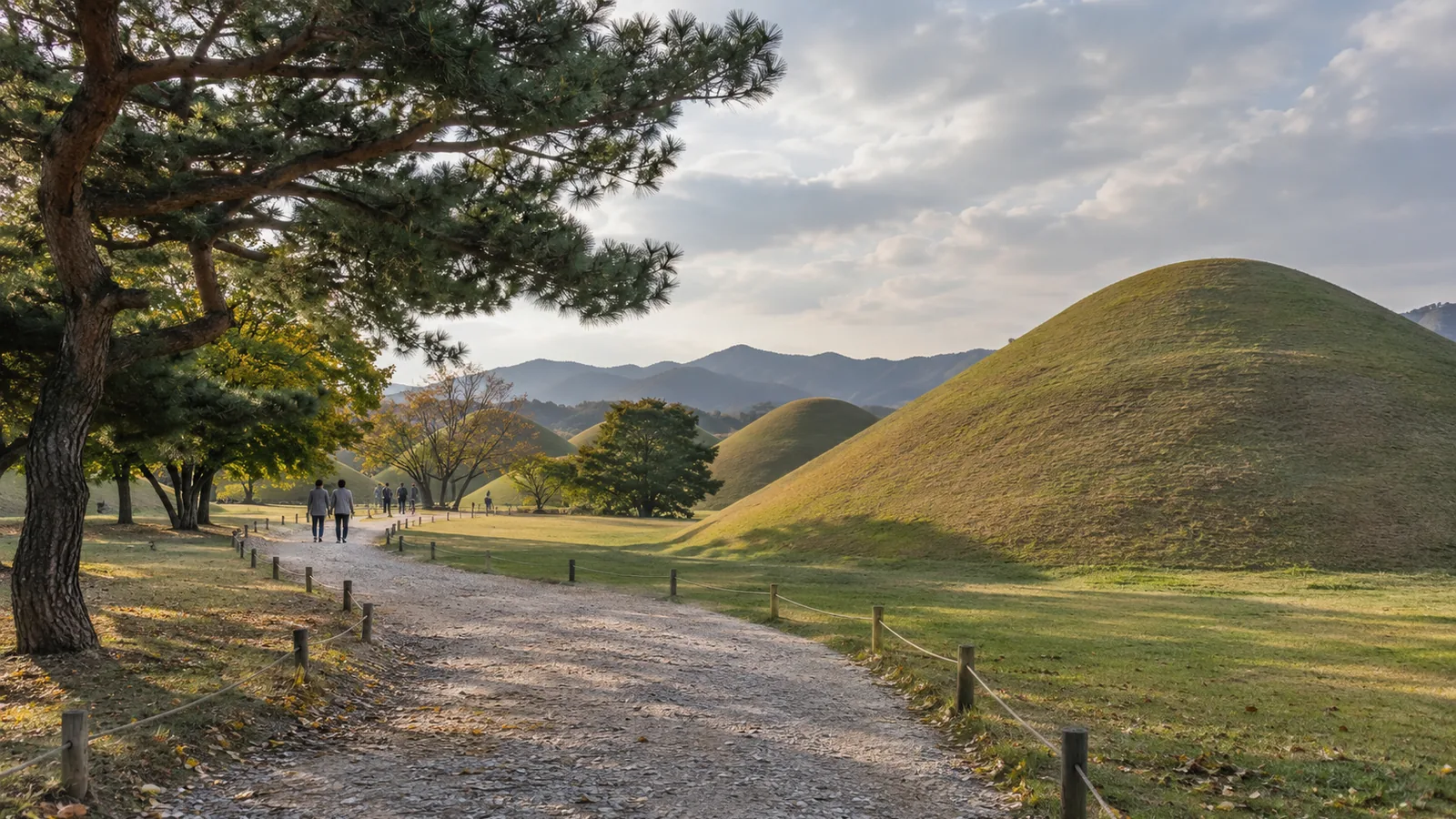
Gyeongju was the capital of the Silla kingdom for close to 1,000 years, from 57 BCE to 935 CE, and it still looks the part. Grass-covered royal tombs sit in the middle of town, there's a 7th-century stone observatory on a lawn, and a mountain temple from 774 outside the city. It holds two UNESCO World Heritage listings, plus a third shared with another village. It's a small, walkable city, about 30 minutes from Busan by KTX, and one of the best additions to a Seoul and Busan trip.
The Korea Tourism Organization puts two Gyeongju entries on its must-visit list for 2025 to 2026: the Daereungwon tomb area (with Donggung Palace and Wolji Pond, Cheomseongdae, Hwangnidan-gil and Woljeonggyo Bridge), and Bulguksa with Seokguram. That's your day and a half right there.
Bulguksa Temple and Seokguram Grotto
Bulguksa, dated by UNESCO to 774, is a temple complex of stone terraces, bridges and pagodas on the slopes of Tohamsan, southeast of the city center. Higher up the mountain, Seokguram is an 8th-century grotto holding a large seated Buddha that UNESCO calls a masterpiece of Buddhist art in East Asia. The two were inscribed together in 1995. Go to Bulguksa first, then continue up to Seokguram.
The temples set their own hours and entry rules, and the city of Gyeongju refers visitors to the temples' own websites rather than listing them. We couldn't confirm current hours or fees from an official page in October 2026, so check bulguksa.or.kr and seokguram.org before you go, or call Bulguksa at 054-746-9913.
Things to do in Gyeongju's historic center
Daereungwon tomb park and Cheonmachong
Daereungwon is a park of huge grassy burial mounds in the middle of town, and entry to the park is free. Inside, Cheonmachong is the one tomb you can enter. KTO notes it was the first royal tomb opened to the public and is named for a painting of a heavenly horse found inside. It's part of the Gyeongju Historic Areas, inscribed by UNESCO in 2000.
Cheomseongdae Observatory
A short walk from the tombs, this stone tower was built during the reign of Queen Seondeok (632 to 647) and is considered the oldest surviving astronomical observatory in Asia. It's free, and it's small, so ten minutes is enough unless you're lingering for photos.
Donggung Palace and Wolji Pond at night
The reconstructed palace pavilions reflected in the pond after dark are the picture most people bring home from Gyeongju. Go at dusk, when the lights come on. The city warns that the pond gets very busy with people coming for the night view, and if you arrive close to the last-entry time you may not get in. Entry is ₩3,000 (about $2.25 at October 2026 rates).
Hwangnidan-gil and Woljeonggyo Bridge
Hwangnidan-gil is the street of cafes, small restaurants and shops beside the tomb park, and the easiest place to eat between sights. Woljeonggyo Bridge is grouped with it on the KTO list and is close to Wolji Pond, so walk the two together in the evening.
Bunhwangsa Temple
A quieter stop near the historic center. KTO notes that Bunhwangsa's stone brick pagoda is the oldest stone pagoda remaining from the Silla period, and the city lists the temple among its free-entry sights. It makes an easy add-on between the tomb park and your next stop.
Yangdong Folk Village
Out of town to the northeast, Yangdong is what KTO calls Korea's largest traditional village: tile-roofed yangban houses up on the hills, thatched houses below, and people still living there. Together with Hahoe it was inscribed by UNESCO in 2010 as Historic Villages of Korea. Entry is ₩4,000 (about $3). Allow half a day with the bus or taxi ride.
Gyeongju entry fees at a glance
| Sight | Adult fee | About in USD |
|---|---|---|
| Daereungwon tomb park | Free | Free |
| Cheonmachong tomb | ₩3,000 | $2.25 |
| Donggung Palace and Wolji Pond | ₩3,000 | $2.25 |
| Cheomseongdae | Free | Free |
| Bunhwangsa Temple | Free | Free |
| Yangdong Village | ₩4,000 | $3 |
| Bulguksa and Seokguram | Set by the temples; check their sites | Varies |
Children 6 and under and adults 65 and over get in free at the city-run sites, per the Gyeongju city admission page. The city notes that temple and museum fees and hours can change, so confirm before you go. Hours and closing days aren't listed there, so call the site or the 1330 travel helpline if you're arriving late.
How to get to Gyeongju, South Korea
By KTX, the city of Gyeongju lists Seoul to Gyeongju at 2 hours 10 minutes, Dongdaegu (Daegu) to Gyeongju at 20 minutes, and Busan to Gyeongju at 30 minutes. Trains from Seoul Station run roughly hourly from 7:37 until late evening. The high-speed stop is Gyeongju Station at 80 Gyeongjuyeok-ro in Geoncheon-eup, outside the historic center, so plan on a bus or taxi into town. Trains from Suseo (the former SRT, run as KTX since September 1, 2026) stop here as well; SRT route lists call the station Singyeongju, so don't let the two names confuse you.
Flying in? The city lists a shuttle from Gimhae Airport (Busan) for ₩9,000 (about $6.75), and bus 1000 from Pohang Airport. Buses are also the backup from other cities: express buses from Seoul's Express Bus Terminal take about 3 hours 30 minutes, and intercity buses from Busan take about 50 minutes to 1 hour 10 minutes. Our getting around South Korea guide covers booking trains in the Korail+ app, and the Busan guide is useful if you're doing Gyeongju as a day trip from there.
Where to stay in Gyeongju and how long to spend
Stay one night if you can. The night view at Wolji Pond is the best part, and it's a long day from Seoul. Base yourself near Hwangnidan-gil and Daereungwon for walking access to the tombs, Cheomseongdae and the pond. If you'd rather have a big hotel and drive, look farther out and use a taxi for the evening. Our where to stay guide compares hotel types.
A good plan: arrive by late morning, walk Daereungwon, Cheonmachong and Cheomseongdae, eat on Hwangnidan-gil, and finish at Wolji Pond and Woljeonggyo after dark. Next morning, Bulguksa and Seokguram, then on to Busan. See how it fits a full trip in our South Korea itinerary, or compare it with other options in things to do in South Korea.
Frequently asked questions
Is Gyeongju worth visiting?
Yes, if you like history. It was the Silla capital for nearly 1,000 years and has two UNESCO World Heritage listings, plus Yangdong Village, all within a compact, walkable center.
How long is the KTX from Seoul to Gyeongju?
The city of Gyeongju lists the KTX at 2 hours 10 minutes from Seoul. From Busan it is about 30 minutes.
Is one day enough for Gyeongju?
One day covers the tomb park, Cheomseongdae and Wolji Pond, or Bulguksa and Seokguram, but not both comfortably. Stay one night to see the pond after dark and the temples the next morning.
Is Daereungwon free to enter?
Yes, entry to the Daereungwon tomb park is free. Going inside Cheonmachong tomb costs ₩3,000 for adults, about $2.25 at October 2026 rates.
How far is Bulguksa from downtown Gyeongju?
Bulguksa is on the slopes of Tohamsan southeast of the center, with Seokguram higher up the same mountain. Take a city bus or taxi, and allow half a day for both.
Sources
- whc.unesco.org/en/list/736
- whc.unesco.org/en/list/976
- whc.unesco.org/en/list/1324
- english.visitkorea.or.kr/svc/contents/contentsView.do?vcontsId=145437
- english.visitkorea.or.kr/svc/contents/contentsView.do?vcontsId=172555
- english.visitkorea.or.kr/svc/contents/contentsView.do?vcontsId=139778
- www.gyeongju.go.kr/tour/page.do?mnu_uid=4838&
- www.gyeongju.go.kr/tour/page.do?mnu_uid=4846&
- www.gyeongju.go.kr/tour/page.do?mnu_uid=4847&
- www.gyeongju.go.kr/tour/page.do?mnu_uid=4781&code_uid=1044
- www.gyeongju.go.kr/tour/page.do?mnu_uid=4785&code_uid=1048
- www.srail.or.kr/cms/archive.do?pageId=KR0405000000
- info.korail.com/info/contents.do?key=717
Prices, schedules and entry rules change. Confirm details with official sources and operators before you travel. See our terms of use.